Making sense of what others overlook
Many people ask me, with that faintly suspicious narrowing of the eyes — “So what exactly is it that you do?” And, to be fair, it’s not the easiest question to answer. My field — this new, evolving discipline that sits somewhere between environmental science, governance, and plain common sense — doesn’t fit neatly into an existing box.
As I’ve written before on this blog, my mission is to help people understand how to think about sustainability — not as a slogan or a checklist, but as a living, breathing process that actually connects with human systems. It’s one of those things that’s hard to define but easy to recognise when you see it.
Let me give you an example.
The Planning Predicament
At a recent conference, the conversation, as ever, turned to “reforming planning” and “unlocking productivity.” Stirring stuff — except that I found myself inwardly groaning at a familiar blind spot. Because every time planning reform is mentioned, someone eventually says that we need to “simplify” environmental law — and that, my friends, is where alarm bells should start ringing.
The danger is not that the laws themselves are bad, but that they’re being applied in ways so cumbersome and expensive that people want to throw the baby out with the bathwater.
The problem is cultural, not structural. It’s not the environmental process that’s the villain — it’s the way we’ve allowed it to ossify into a cottage industry of forms, reports, and appendices that seem designed more to justify themselves than to inform anyone.
This isn’t cynicism; it’s observation.
The Great Tome Tradition
If you’ve ever seen an environmental report, you’ll know what I mean.
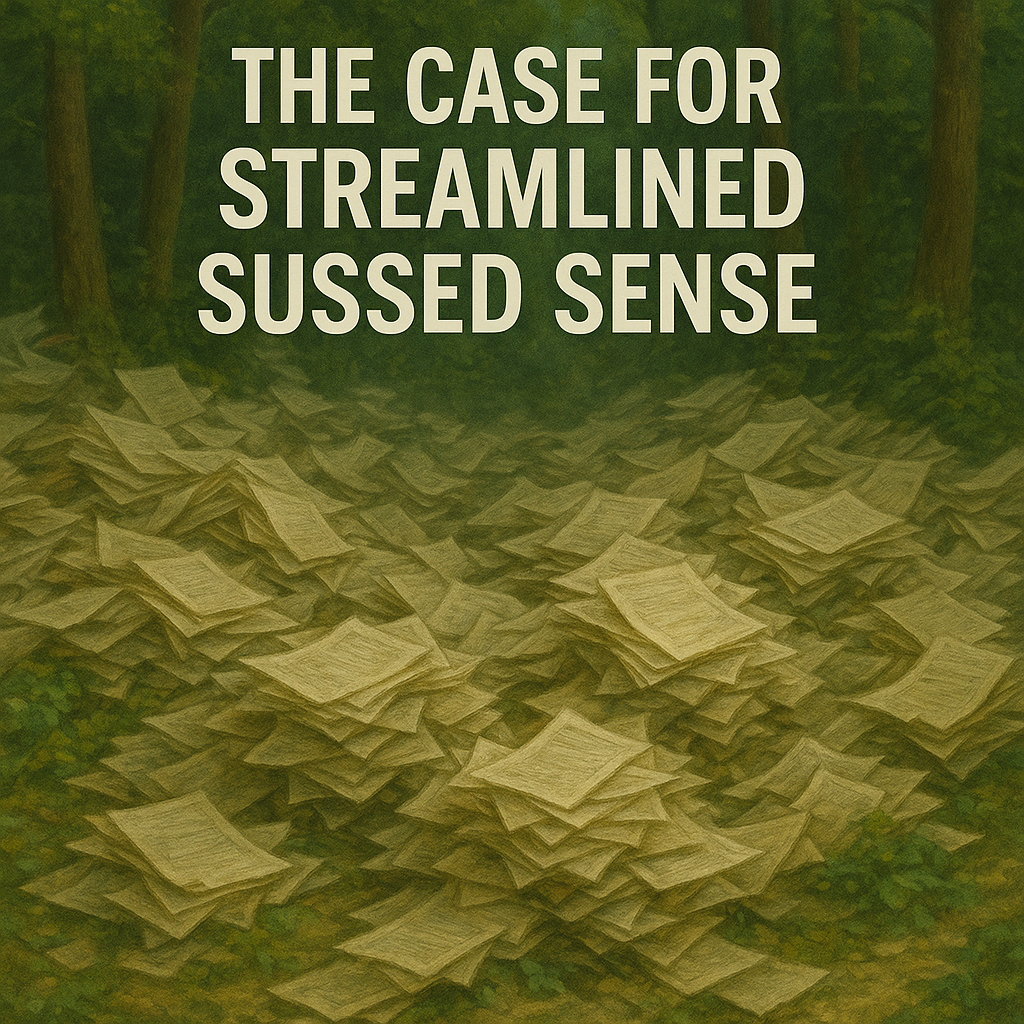
They come in ring-binders the size of paving slabs, full of earnest tables, labyrinthine text, and footnotes that could tranquillise a rhinoceros.
Now, these things have their place — but let’s remember what they were originally for. The whole purpose of environmental legislation, going back decades, was to give the public a say in how their communities evolve: where the houses go, where the roads run, how the landscape changes.
Yet these reports are now so dense that the very people they were designed to empower can’t get near them. The language is alien, the format is bureaucratic, and the process — well, it can feel like the bureaucratic equivalent of trench warfare.
Instead of drawing people in, we’ve built a paper wall that keeps them out.
The Consultation that Never Was
Every policy forum I’ve ever attended says the same thing: “We must consult early! We must bring stakeholders in!” And yet, in practice, the consultation comes after the real decisions have already been made.
If we were serious about public engagement, we’d treat environmental documentation as a marketing tool — not in the cynical sense, but in the sense of communication. We’d publish clear, accessible, even visually engaging documents that say to the local community:
“This is what’s coming. This is what it could look like. This is why it matters. Tell us what you think.”
Imagine that. Instead of a weary PDF no one reads, we’d have a shared vision of place, sustainability, and purpose.
It wouldn’t just build consent — it would build enthusiasm.
The Process, Not the People
Now, let me be absolutely clear: this is not an attack on environmental consultants. Many of them are as frustrated as I am. They’re working within systems that reward length over clarity, caution over confidence.
And yes, there’s a reason for that. Clients want to minimise risk. Regulators want exhaustive proof. Everyone wants to be able to say, “Well, we followed the process.”
But the net result is paralysis by procedure. The legislation doesn’t demand it — we do.
We’ve confused diligence with excess, mistaking the performance of rigour for rigour itself.
Expertise with a Purpose
My own expertise — born out of years of practice and a PhD exploring the roots of environmental assessment — is to strip this complexity back to first principles.
Environmental law, in its pure form, is a brilliant piece of democratic machinery. It gives the public a stake in their environment and forces decision-makers to justify their choices. But when we make the process so complicated that only professionals can understand it, we destroy its legitimacy.
That’s the irony. By making environmental assessment appear forbidding, we undermine the very trust it was designed to build.
I’ve seen how easily it can be done differently. A social or environmental impact assessment can be produced quickly, cheaply, and intelligently if you design the process right. It’s not about cutting corners — it’s about cutting nonsense.
The System’s Short-Sightedness
What worries me is that successive governments, seeing only the bloated output, will simply decide to get rid of environmental assessment altogether. And given some of what I’ve seen in practice, they might even feel justified.
That would be a tragedy. Because the environmental laws we have — the Environmental Assessment Directive, the EIA, the SEA — were crafted by people who genuinely understood what “sustainability” meant long before it became a buzzword.
They built systems that could last. We’ve just forgotten how to use them properly — or perhaps we were never really taught to. More likely, the experts who truly understood how these processes were meant to work were never given the keys to drive the vehicle in the first place.
In Defence of Simplicity
The truth is, the system doesn’t have to be like this. Streamlined processes are not weaker — they’re stronger, because they actually deliver understanding.
What we need is advocacy for clarity — for lean, efficient, intelligent assessments that work with communities, not around them. At the moment, there’s no real voice for that approach. Everyone’s too busy ticking boxes.
It suits the short-term players. But long term, it’s a recipe for the entire system being scrapped — and once that happens, the environmental safeguards that took half a century to build will never return.
The Outlier’s Drum
So yes, perhaps that makes me an outlier — one of the few still making the case for simplicity, early engagement, and real environmental literacy.
But I’ll keep banging that drum, because the alternative is a slow bureaucratic extinction of environmental sense — and that, frankly, is madness.
If you’re interested in how environmental and social assessments can be done properly — quickly, clearly, with genuine insight — come and talk to me. Because sustainability, in the end, isn’t about slogans. It’s about how well we think.