Why old institutions still matter in a fracturing world
The earth is rumbling beneath our democratic boots. Not with the thunder of war, but with the grinding churn of political realignment, institutional fatigue, and geopolitical bewilderment. The grand edifice of liberal democracy—a structure built upon the blood, sweat, and Magna Carta-soaked tears of centuries past—is lurching, groaning under the strain of a new geopolitical order. The big question, my friends: are we tumbling headlong into the gloaming of a great democratic dusk; or just perhaps squinting at the first rays of a glorious rebirth?
Let us not delude ourselves. The EU moves too slowly. The UK is economically dwarfed. The Commonwealth is barely understood by its own youth. But together, through voluntary cooperation and shared investment, they could create something both nimble and principled: a network of democracies big enough to matter, but modest enough to listen. If democracy is to survive this century’s autocratic headwinds, it must become again what it once promised to be: not an exclusive club of elites, but a common home of free people. How do we get there? Here's an idea. It already has legs. Read on.
The world, once so comfortably chaperoned by the benign hegemony of Uncle Sam, is now convulsed with doubt. The United States—formerly the orchestra conductor of the post-war liberal symphony—has ditched the baton and taken up the tuba, thumping out a solo of economic nationalism and unilateral swagger. Under the enduringly coiffured Donald J. Trump, “America First” has leapt off the bumper sticker and into the policy ledger. No more multilateralism. No more moral leadership. Just deals, dollars, and the dazzling bluster of transactional politics (Brookings, 2024; Atlantic Council, 2024).
Take the cosy courtship with Saudi Arabia, for instance. Eye-watering oil deals—spiced with reinvestment pledges—have poured billions into Boeing and friends, like a golden river through a Texan gulley (Reuters, 2024). And lest we forget, this is a country that once stuck its head out of the window and yelped about liberal values. Now, we’re back to realpolitik, baby, and the price tag on American virtue is apparently negotiable.
All of this has left the rest of us in a bit of a tizz. Europe—dear, dithering, democratic Europe—finds itself diplomatically disrobed, standing like a startled bather as the tide of global relevance rushes out. Even with a GDP north of $20 trillion (IMF, 2024), the EU has all the strategic alacrity of a snail in a bureaucratic maze. Meanwhile, Blighty (a.k.a. the UK) hums along with a tidy $3.6 trillion economy (ONS, 2024), which is lovely, until you realise it’s roughly the size of California. And not even the expensive bit.
In truth, for all our high-minded conferences, regulation-rich policy gardens, and ancient parliamentary flourishes, we—the EU and UK alike—are simply not big enough, nimble enough, or united enough to face down the financial firehoses of Washington or the farmed-debt-draped ambition of Beijing. Worse still, the very forces that are driving our domestic disenchantment—the slow erosion of trust in traditional parties, the rise of populist insurgencies, the spectacle of powerless councils fretting over planning permissions while autocratic billionaires gobble up entire neighbourhoods—are not purely homegrown. They are the by-products of a global system increasingly dominated by authoritarian capital, where influence is wielded not with tanks but with telecoms, ports, universities, and stadiums. To the Tommy Robinsons of the world: you’re not saving democracy—you’re dancing to the tune of those dismantling it. Unless liberal democracies forge a common cause, we risk becoming the fragmented subsidiaries of an autocratic monopoly. The rules-based order is under siege, and if we do not act now, there may be no stage left upon which democracy can perform.
Now, here comes the crunch: the UN—oh yes, that well-meaning conclave of consensus and cappuccinos—is found wanting. Originally forged with all the lofty aspirations of a Platonic republic, it now slumps under the sheer gravitational force of its own contradictions. A democratic ideal? Perhaps in principle. But in practice? Paralysed by vetoes, dominated by autocrats, and increasingly the geopolitical equivalent of a parish council with delusions of grandeur (Chatham House, 2023); Foreign Policy, 2024).
Meanwhile, the clouds darken. Russia rattles its sabres (BBC, 2024), China farms the world with debt (Council on Foreign Relations, 2023), a modern incarnation of what Gore Vidal once described as 'the perpetual war for perpetual peace'—where economic entanglement becomes a subtle, if insidious, form of imperialism (Gore Vidal, 2002). Meanwhile, America—no longer the swaggering sheriff of the free world—sits glowering in the corner, scowling at its own tariff tables and muttering about steel quotas like a retired boxer nursing old bruises. Gone is the sense of camaraderie; in its place, a transactional truculence that leaves allies feeling jilted. When the world's erstwhile champion of liberal democracy starts playing the role of mercantile misanthrope, it rattles the bones of the entire rules-based order.
So, where do we go? Where is the refuge for liberal values, civic trust, and good, old-fashioned habeas corpus? Enter, from opposite wings of the great democratic theatre: the European Union and the Commonwealth.
The EU is a supranational bloc of 27 member states, bound by treaties and a shared commitment to democratic governance, human rights, and the rule of law (European Commission, 2024). It boasts a powerful regulatory framework and has been a global trendsetter in areas like data privacy (hello, GDPR), climate policy, and market integration. The Commonwealth, by contrast, is a voluntary association of 56 independent nations—spanning Africa, Asia, the Americas, Europe, and the Pacific—united not by enforcement but by shared values rooted in democracy, development, and diversity (Commonwealth Secretariat, 2024). It lacks binding legal mechanisms, but makes up for it with a deep bench of soft power, institutional cooperation, and cultural affinity.
To many, the Commonwealth seems a relic—an imperial afterthought with an anachronistic name. But peer beneath the surface, and a different picture emerges. The Commonwealth isn’t a military alliance or a trade bloc. It’s something more subtle, more flexible. A sort of civic scaffolding. From education and electoral support to legal training and climate cooperation, it has evolved into a web of institutional resilience and peer-to-peer development. Countries like Ghana, Kenya, and Bangladesh continue to draw value from Commonwealth legal networks, election monitoring, and youth programmes—quiet instruments of stability in a noisy world. Even Rwanda, with no colonial past under Britain, saw merit in joining this club—not for nostalgia, but for opportunity.
And this is where Britain, battered but not beaten, could find its niche—not as the overlord of empire redux, but as the bridge between the great liberal clubs of the world. A post-Brexit UK, freed from EU regulation but still steeped in its democratic ethos, sits uniquely positioned. It speaks the lingua franca of the Commonwealth. It understands the regulatory poetry of Brussels. It houses venerable institutions and still commands soft power—though some of it lies dormant, gathering dust like a WWII radio in a BBC sub-basement.
Ah yes, the BBC. Once the jewel in the crown of soft power projection. From Bush House to Bengal, the BBC World Service gave voice to the voiceless, offered facts amidst propaganda, and anchored liberal democratic identity across continents. But in recent years, funding cuts, digital competition, and political neglect have eroded its reach (The Guardian, 2023). The signal that once reached refugees and reformers alike now crackles with doubt.
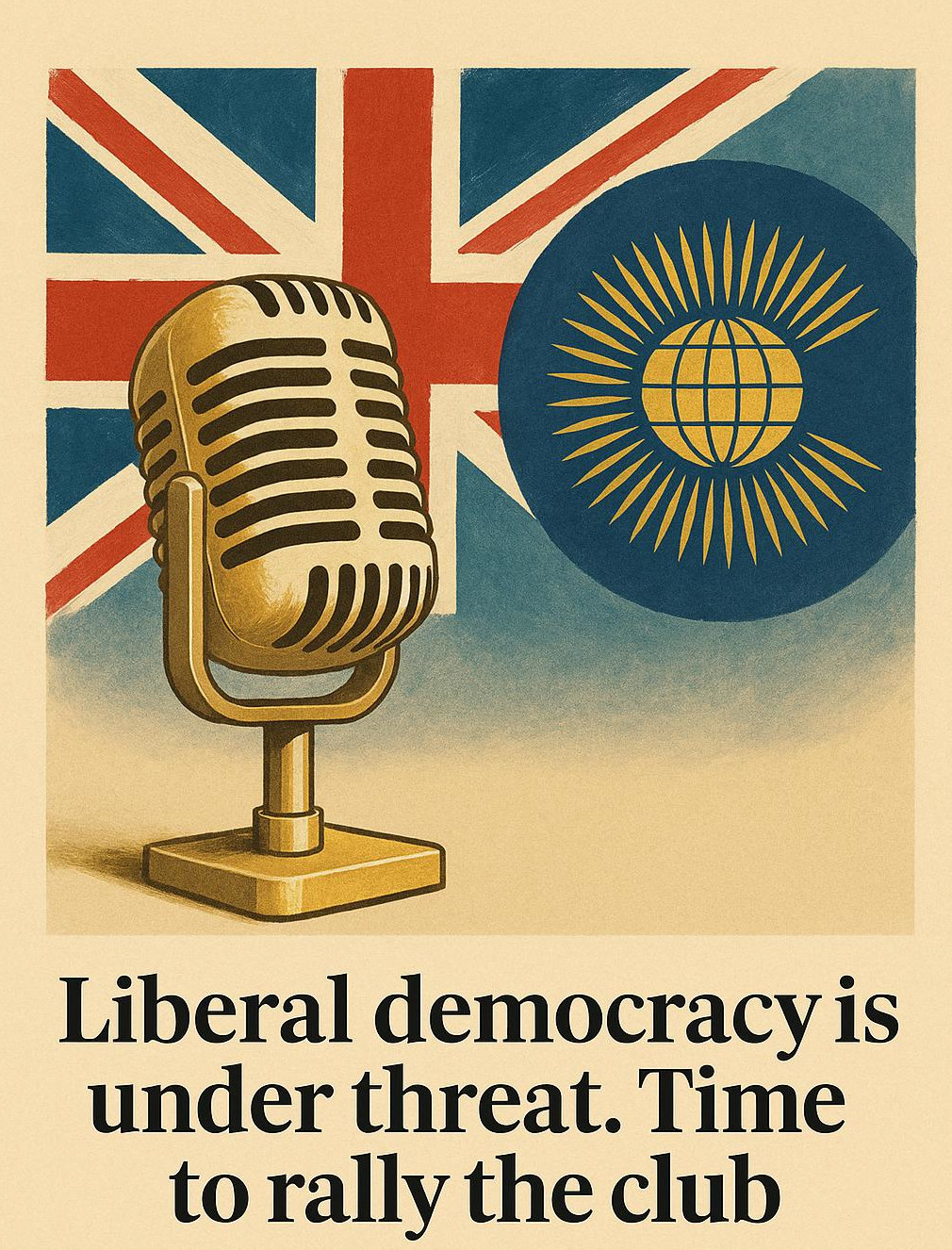
Here lies the opportunity: revive that spirit. Build a Commonwealth World Service. A modern multimedia platform—part broadcaster, part civic space—that tells the stories of democratic cooperation, development success, legal resilience, and cultural pluralism from across the Commonwealth. With content shared, produced, and shaped by all members—from Canada’s media giants to Nigeria’s cultural storytellers, from Australia’s tech hubs to India’s educational innovators—it could become a people-powered media network for democratic values. Not propaganda. Not empire. But a common voice for the common good.
This isn't sentimental puffery. It is strategic necessity. In a world where authoritarian regimes invest billions in narrative warfare—China’s CGTN, Russia’s RT, even the weaponised meme accounts of digital trolls—liberal democracies have ceded too much ground. A new Commonwealth platform could reassert informational trust, forge democratic belonging, and remind citizens—from Lusaka to London, Delhi to Dunedin—that they are part of something greater than the algorithm.
And what’s more—Donald Trump wants in. Reports from The Financial Times, 2024 suggest Trump, ever the marketer of nostalgia, has flirted with the idea of the U.S. engaging with the Commonwealth as a symbolic realignment of values. One could laugh—or one could recognise the deeper point: even the architects of democratic backsliding can see value in its structures. That alone should jolt the rest of us to action.
So let’s not mourn. Let’s build. Under threat, yes—but with resilience. With history behind us, technology around us, and values within us. This may yet be democracy’s finest hour. But only if we seize the moment.
The EU, for all its sclerosis, remains a regulatory titan. It can—and must—step beyond reactive policy and reassert its normative power. It has already done this with GDPR, carbon markets, and digital competition law. It can lead again—on AI ethics, climate governance, and democratic integrity. But it cannot do it alone.
The Commonwealth, too, must step up. It cannot hide behind voluntaryism or lean on vague charters. Its strength lies in its flexibility, its moral community, and its geographic spread. But if it wishes to be more than a soft relic, it must become a platform—for civic mobilisation, innovation, and democratic resilience.
And Britain—ah, dear Blighty—must stop equivocating. It must stop framing its future as a binary choice between Brussels and Washington. It is uniquely positioned to act as a bridge between the EU’s institutional heft and the Commonwealth’s global reach. It can pioneer a bottom-up model of democratic cooperation—federated, flexible, values-driven.
We don’t need another empire. We need a club of equals—willing to share infrastructure, communications, research, and resilience in defence of democracy. And we already have the scaffolding. It’s called the BBC World Service.
Yes, it’s underpowered. Yes, it’s underfunded. But it’s also underappreciated—and its potential, like that of liberal democracy itself, remains vast.
So let us make that investment now. Let us give voice to our values. A Commonwealth World Service. Let us forge a future worthy of our shared past.
Because if we don't, others will write the rules for us.