Why automation changes the rules faster than policy can keep up
So here we are again—clutching our Union Jack mugs and staring slack-jawed at yet another tariff skirmish, this time unfolding like a grimly repetitive soap opera between Washington, Beijing, Brussels and whoever else has decided to pick up the sabre and give it a good old rattle.
Donald Trump—whose economic diplomacy is about as subtle as a rhinoceros in a crystal shop—wants to slap tariffs on everything from microchips to microwaves in the hope that American jobs will come galloping back over the hill like the cavalry at Balaclava.
And yet, dear reader, despite all the furious flag-waving and trade bluster, those jobs do not come. They do not gallop, they do not trot—they simply vanish. First to China, then to Vietnam, now to India. Not unlike the eloping lovers in a farce, they dart from one stage-left exit to another, pursued not by a bear, but by global capital seeking the cheapest possible labour.
Take Apple. The Californian tech colossus has decided—quelle surprise—not to bring its shiny little gizmos home to the land of the free, but instead to ramp up production in India. Why? Because the economics, like the laws of gravity or toast falling butter-side down, are unavoidable. Indian wages are lower. Production is cheaper. It’s that simple. [Financial Times, 26th April 2025]
The same pattern plays out across the world. Tariffs are supposed to bring jobs back. But what actually happens? They don’t return to Detroit or Dagenham. They just hop sideways—to the next country on the global Monopoly board where wages are sufficiently meagre and unions blissfully absent.
And here lies the rub. The Western world—bless it—wants to eat its industrial cake and have it too. We want well-paid workers, sovereign supply chains, and shiny manufacturing plants run by proud workers in hi-vis jackets, clipboards in hand and hard hats askew. But we also want low inflation, cheap trainers, and our Amazon parcels delivered yesterday. It doesn’t add up.
Now, let’s take a short detour—on horseback, perhaps—through history.
Why did Rome dominate the known world? Was it just the legions, the sandals, the togas? No—it was the water. Rome, splendidly plonked in the centre of the Mediterranean, controlled the shipping lanes like a toddler hogging the paddling pool. The empire was as much logistical as it was martial. [See: David Abulafia, Fernand Braudel]
And Britain? Ah, glorious Albion! We harnessed the trade winds, built oak-framed ships the size of cathedrals, and merrily charted our way around the globe—transporting goods, spices, and, regrettably, slaves. We ruled not because we were the nicest, but because we moved fastest. Geography was king. Energy—the wind, the tide—was queen.
Then came coal. Steamships. Diesel. Suddenly, every nation could shove goods across oceans. Geography no longer mattered. And once the energy advantage was erased, what became the new currency of industrial power?
Labour. Cheap, cheerful, and—if you're an unscrupulous conglomerate—endlessly exploitable.
India and China, with their teeming populations, became the factories of the world not because they invented a better widget, but because their workers cost one-tenth of ours. The UK simply cannot compete when the person on the other end of the supply chain earns in a week what a British warehouse manager earns before tea. [World Bank Labour Statistics, 2024]
So here’s the quandary: we can’t lower wages—unless we’re in the business of political self-immolation. No government survives an election by proposing Victorian working conditions. Nor can we force global firms to repatriate their factories with threats and tariffs. Capital, like water, finds the path of least resistance.
What’s left?
Well, here's a radical notion: don’t replace foreign workers with British ones. Replace them with machines.
Enter the robots.
These gleaming, efficient, unfussy fellows—and yes, ladies, non-binary bots and all—are not here to take your job. They’re here to take the job no one wants, at a cost no Western worker could stomach. They don’t demand coffee breaks, they don’t strike, and they don’t spend their weekends heckling Question Time. They just work.
And guess what? They're already here. Germany’s car factories hum with robotic arms. South Korea has more robots per capita than any country on Earth. Even the Americans—ever late to the party—are waking up. [IFR World Robotics Report, 2024]
In the UK, the signs are stirring. Gigafactories are emerging in Sunderland and Somerset, with the likes of AESC and Agratas investing billions into next-generation battery plants that are, if not fully automated, then close to it. Meanwhile, IONETIC’s Arc Fab Pilot Facility in Brackley is showcasing the future of domestic battery innovation with its use AI-powered control systems. These are no longer plans on paper—they are infrastructure on the ground. A new industrial chapter is beginning to be written.
Together, these industries are expected to contribute billions to the UK’s gross value added (GVA). The battery sector alone is projected to support a significant share of the UK's future automotive economy, while related advanced manufacturing and clean-tech sectors are gaining traction. When quantified, this wave of automation—if nurtured—could constitute a sizeable and growing share of national productivity.
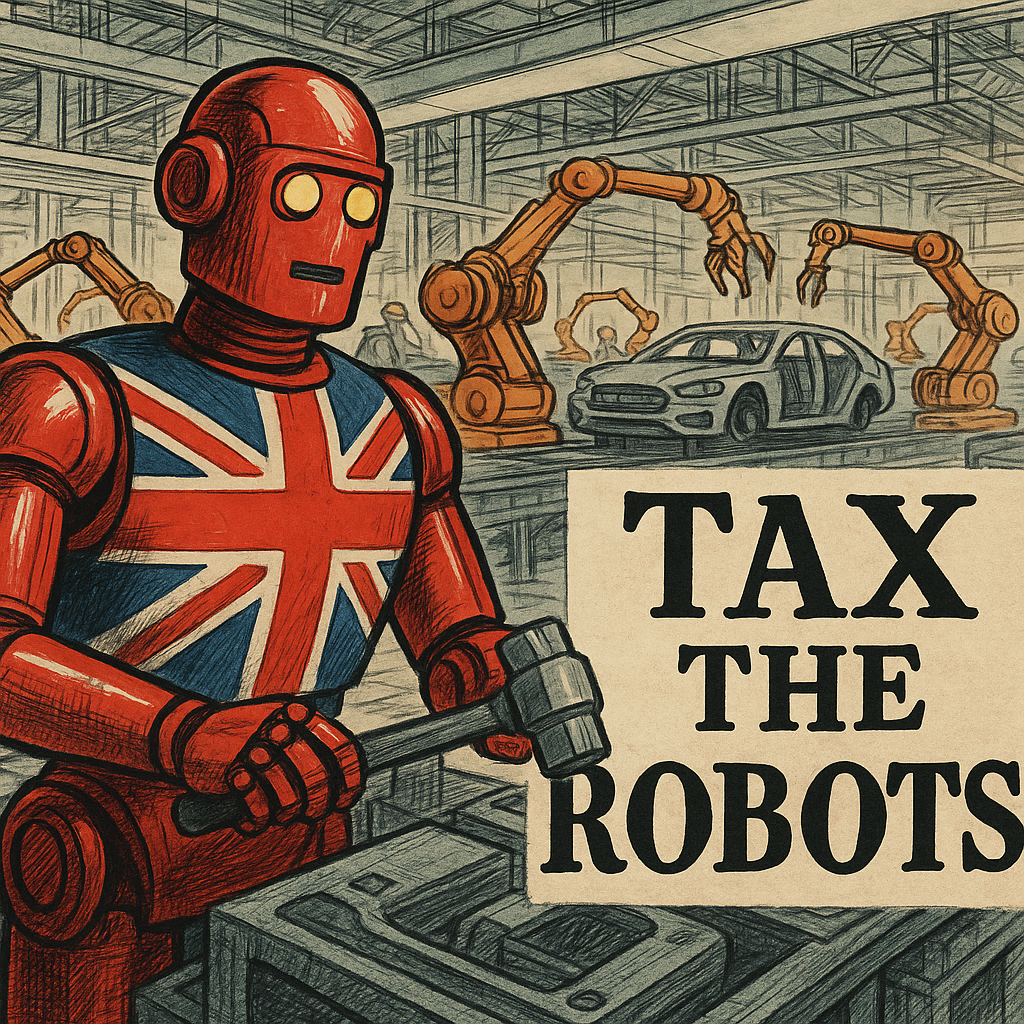
But here’s the catch. If we go full metal jacket on automation without a plan, we risk creating a society where productivity soars but human dignity plummets. Where GDP ticks merrily upward while communities fall apart. Robots don’t pay income tax. They don’t shop locally. They don’t send their kids to school. If they replace workers, and the tax base withers, who funds the NHS? Who pays for the potholes?
This is where our thinking must become as bold as our engineering. We must recognise that sustainability is not just about emissions targets and green slogans—it is about systems that endure. The great opportunity of automated reindustrialisation is that it allows us to align productivity with sustainability: championing the social and the eco. An automated factory, powered by low-carbon energy and operating near its market, produces fewer emissions than a sprawling supply chain spanning multiple continents. By bringing production closer to consumption—and designing it to be efficient, clean, and circular—we can shrink carbon footprints, reduce waste, and build resilience into our economy and not just this website. This is not a romantic return to smokestacks and soot. It is a forward-looking, digitally governed, environmentally responsible model of industry. And it is precisely the kind of economy that deserves to be taxed fairly, because it can afford to be, and because it must support the social and environmental contracts on which it relies.
So: Tax the robots?
Its tempting to say yes.
This idea was once floated—rather sensibly, I thought—by none other than Bill Gates. The logic is disarmingly simple: if a robot performs a human job, the economic value of that labour still exists. Tax a portion of it. Redirect the proceeds to society. [Gates interview, Quartz, 2017]
South Korea, always one step ahead in sci-fi matters, has already nibbled at this policy—reducing tax incentives for automated firms. The world has not ended. [Korea Herald, 2022]
We could use this tax to fund a renaissance in civic life: universal basic income, three-day weeks, retraining schemes, libraries, arts centres, functioning train stations. All the things we used to believe were part of a civilised society before accountants convinced us otherwise.
But this is where the conversation must mature. The question is not whether to tax robots, but how to ensure that the economic value they generate does not slip cleanly through the fingers of the state. Automation does not eliminate value—it redistributes it, away from labour and into capital. If we fail to adjust accordingly, we risk building an economy that is highly productive, yet fiscally hollow.
That would be the true dystopia: factories humming, output rising, and yet the public realm quietly starving. No funding for the NHS, no investment in infrastructure, no renewal of civic life—just growth without distribution.
The answer, therefore, is not to penalise automation itself—we need it, desperately—but to capture a fair share of the surplus it creates. That may mean rethinking how we tax profits, capital flows, and the increasingly intangible assets that underpin automated production. It certainly means closing the gap between where value is created and where it is taxed.
And this, dear reader, is where the UK might actually have an advantage. Precisely because we have lost so much of our industrial base—precisely because the factories have fallen silent and the unions no longer hold sway over production lines that no longer exist—we have a blank canvas. We are not burdened by legacy systems or entrenched structures. We can design an industrial model fit for the age of automation, not one inherited from the age of labour.
The fields lie fallow. But the soil is rich. All it needs is strategy, energy, and a bit of vision.
There are entire sectors ready for fully automated revival: electronics assembly, battery manufacturing, pharmaceuticals, 3D printing of construction components, vertical farming, robotic logistics hubs, and even elements of textile production. These industries do not depend on low wages—they depend on high capability, reliable energy, and intelligent policy.
So let us stop mourning the factories of yesterday and start building those of tomorrow. Let’s make Britain not just a buyer of automation, but a builder of it. Let’s create the conditions for investment to flow to Birmingham, Sheffield, Cardiff and Dundee—not out of nostalgia, but because the economics finally make sense again.
And let us be clear-eyed: this movement must begin now. As automation accelerates and its contribution to national output grows, so too must our ability to capture its benefits. If we fail to act, we will not halt the rise of the machines—we will simply ensure that their rewards accrue ever more narrowly.
The real choice is this: shape automation, or be shaped by it.
Tariffs are yesterday’s solution—an economic fig leaf for problems already two steps ahead. If the West wants to reclaim its industrial footing, it must abandon the fantasy of returning to a labour-driven past and instead build a capital-intensive future—one that is competitive, sustainable, and, crucially, fiscally viable.
Let the machines rise. But lets find mechanisms for fair UK civic recompense.