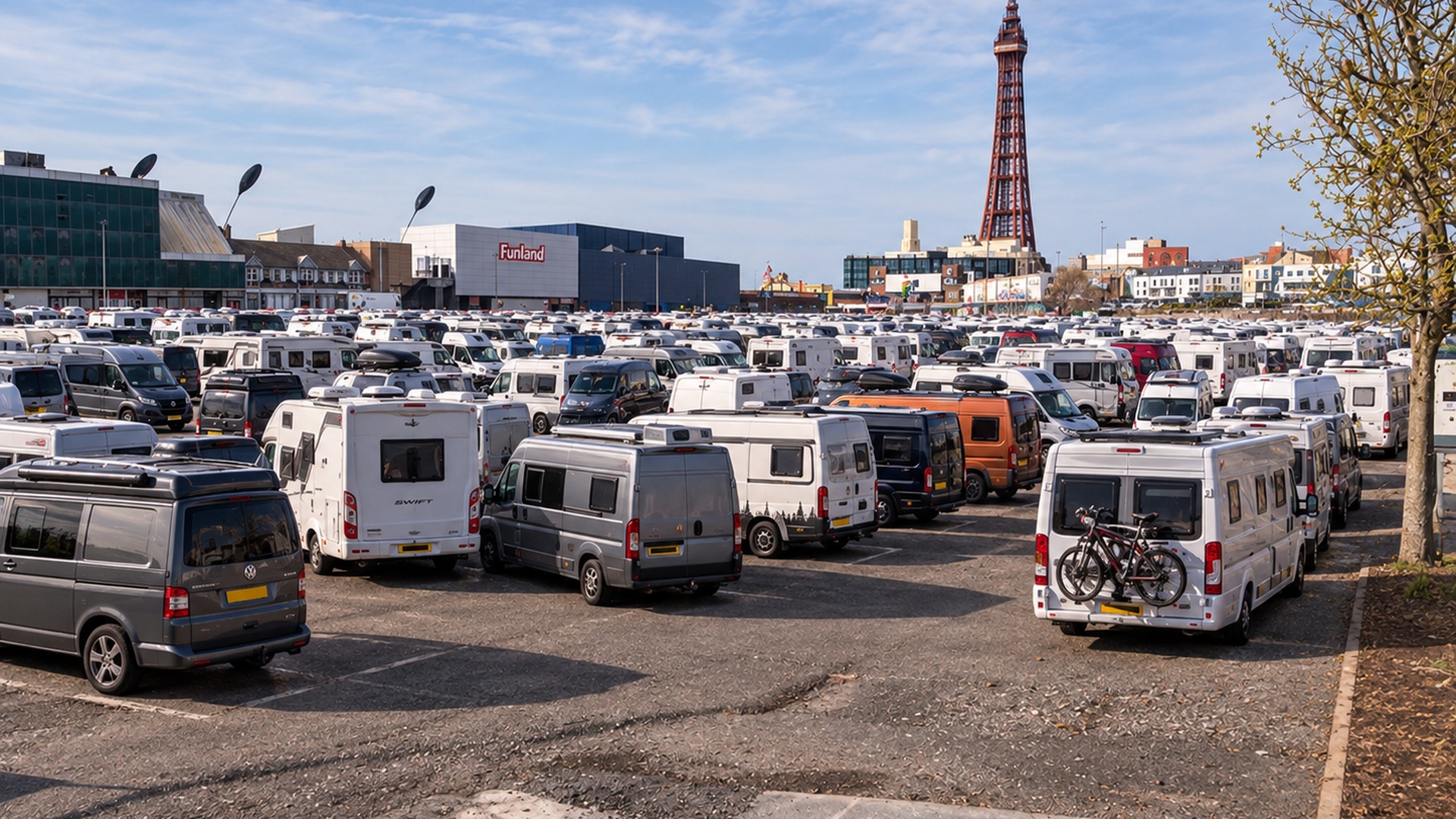
Blackpool has another £300 million vision for Blackpool Central. In fact, this is the second major vision for the site in less than a decade. For anyone familiar with the history of regeneration in the town, it is difficult not to hear the familiar response somewhere in the background: “It’ll end up being another car park.”
It is easy to dismiss that as Blackpool cynicism. It is harder to dismiss the experience that produced it. The previous Blackpool Central vision was enormous. Major attractions, hotels, restaurants and leisure were coming; the images appeared, the hoardings went up and the future acquired that peculiar certainty which only exists in artists’ impressions. Then developer Nikal collapsed, the economics changed and the grand vision stalled. What Blackpool actually got was a 1,300-space multi-storey car park.
Now we go again.
The latest proposal is different, but its vocabulary is unreassuringly familiar: major attractions, commercial space, food and drink, public realm, residential or student accommodation and potentially another hotel, all assembled in pursuit of that holy grail of regeneration, the year-round destination. Perhaps it will be transformational. I sincerely hope it is. But anyone who remembers The Simpsons episode in which Springfield is persuaded by a smiling salesman that prosperity lies at the end of a monorail track might forgive a little caution whenever another magnificent vision arrives bearing jobs, investment and footfall.
Blackpool has certainly invested heavily in its built environment, and much of the physical improvement is there for anyone to see. The more difficult matter is the opaque return on investment. Buildings open, paving improves, ribbons are cut and millions of pounds of investment are announced; the useful questions begin when the photographers have gone home. How much genuinely additional private activity has been created? How much new disposable income is circulating through the town? How much of the activity survives without continued public support? There are small signals worth noticing.
Marco Pierre White’s New York Italian opened beneath the new Holiday Inn at Talbot Gateway in 2024. Less than two years later the relationship had ended and the hotel was forced to bring the restaurant operation in-house. That does not condemn Talbot Gateway; it merely illustrates a truth regeneration sometimes prefers not to dwell upon: An opening is an event. An economy is what happens afterwards.
And this is where the old build it and they will come assumption becomes dangerous. Buildings can be financed. Footfall cannot be summoned by architectural rendering. Perhaps, before Blackpool falls in love with another masterplan, it should consider whether its greatest shortage is really buildings at all.
It may be people.
Look at what Blackpool already has
Stand back for a moment and consider the absurdity of describing Blackpool as a place that needs more things for people to do. Within a remarkably compact town are Blackpool Tower, the Winter Gardens, Sea Life, Madame Tussauds, three distinct piers, theatres, amusement arcades, restaurants, bars, gyms, swimming and leisure facilities and miles of promenade and beach. We have not even reached the Pleasure Beach and its ice rink and, across the road, the water. There is the new Arc Cinema, with Lancashire’s only IMAX and one of the largest IMAX screens in the North West. Beside the Pleasure Beach is the enormous three-storey Velvet Coaster, recently ranked the second best-loved pub in Britain in Google Maps’ national ranking. More than a century of mass tourism has left Blackpool with an extraordinary concentration of entertainment infrastructure.
In many cities, an equivalent collection would be scattered across miles and connected by buses, trains and taxis. In Blackpool, much of it is a walk away. And outside the busiest periods, it is remarkably accessible. Finish work and you can see a film, go to the gym, walk the promenade, have dinner, see a show, meet somebody for a drink or, should judgment temporarily desert you, find yourself singing karaoke. A fantastic offer, yet it is considered not enough.
The challenges arrive on the wet Tuesday, outside peak tourist season. There are not enough people around to sustain the atmosphere that brought you out in the first place. The hotels behind the central area and surrounding housing support a lot of challenged individuals who have come to Blackpool - some would say encouraged - from other deprived areas to forge a lifestyle out of nothing, but they bring deprivation with them and as more arrive it multiplies. Yet the conventional regeneration response is to demolish and build some more.modern "vitality".
Another restaurant supplies more restaurant tables. Another hotel supplies more hotel rooms. Another retail unit supplies another shop. None of these is necessarily a bad investment, but bricks have never possessed wallets, and a restaurant table has yet to buy its own dinner. Across Britain, regeneration schemes increasingly compete for versions of the same imagined population: affluent residents, prosperous professionals, higher-spending visitors and consumers attracted by apartments, attractive public realm, cafés, restaurants and leisure. There is nothing wrong with wanting these people in Blackpool. Bring them. But they are in very short supply and decreasing during our national cost-of-living challenges. Moreover Liverpool wants them. Manchester wants them. Newcastle wants them. Bishop Auckland wants them. Almost every regeneration strategy in Britain seems to have discovered the same prosperous citizen at approximately the same moment, and the poor creature cannot possibly live everywhere.
So I believe Blackpool should ask a question which costs nothing: Who already wants what Blackpool has?
Finding the people
Start with motorhomes and campervans. Here is a population for whom Blackpool need not construct a bedroom. They have brought one with them. What they require is somewhere sensible to stop and sufficient reason to stay. Blackpool has those reasons by the bucketful. During the week, it is potentially the ultimate pit-stop in the UK.
Blackpool does, of course, already make provision for motorhomes, but location matters. Provision tucked behind the main visitor areas and away from the Promenade is a very different proposition from a well-managed stopover in the heart of the resort; for visitors arriving late, particularly those unfamiliar with the town, visibility, lighting, passing activity and a sense of security is important. Location has economic implications too: put people within easy walking distance of the Tower, Central Pier, the Winter Gardens, restaurants, pubs and attractions, and you have put their spending within walking distance as well.
The value of a motorhome arriving on a Wednesday in November extends far beyond the parking charge. Its occupants spend in cafés, pubs, restaurants, shops, attractions and entertainment venues, and that spending takes place precisely when Blackpool's existing businesses need it most. A livelier midweek economy also makes an ordinary hotel break more attractive. A hotelier trying to sell Tuesday, Wednesday and Thursday nights has a much better proposition when the guest knows there will be life beyond the hotel door. More customers allow venues to remain viable for longer; a livelier town then attracts further customers. That is economic development requiring remarkably little concrete.
Which brings us to one of Blackpool’s largest, most visible and most awkward assets.
The hotels we already have
Walk down Bond Street. Look along parts of the Promenade. There is no need for a consultant’s heat map to discover Blackpool’s surplus hotel accommodation. The evidence has windows. Blackpool Council itself acknowledges that the town still has too many holiday accommodation bed spaces and that many businesses operate at marginal levels. Its assessment of South Shore records high vacancy and disrepair, with significant deterioration around Bond Street. We already know where prolonged deterioration can lead: the Ambassador Hotel deteriorated until demolition became necessary, while other substantial hotel buildings have disappeared through deterioration, fire or redevelopment. This leaves Blackpool with a question that deserves rather more imagination than another conversion application: What do we do with a hotel that Blackpool does not currently need as a hotel? Some will have viable alternative uses and should find them. Others may eventually be beyond rescue. But as an environmentalist, I believe allowing useful hotel stock to decay simply because its market is temporarily weak could prove extraordinarily short-sighted. On the current trajectory of climate change, Blackpool could be heading for a significant tourism renaissance within the next twenty years.
Europe is warming rapidly and severe summer heat is increasingly affecting traditional Mediterranean destinations. If that trajectory continues, the geography of the European summer holiday will change with it. A British coastline whose notoriously moderate climate has been the butt of jokes for generations may acquire a rather different commercial value when parts of southern Europe are enduring repeated periods of extreme heat. Blackpool would enter that era with advantages that a newly aspiring resort could spend generations trying to reproduce: miles of beach and promenade, national rail and motorway connections, a famous tourism identity, major attractions, entertainment infrastructure and a vast inheritance of buildings originally constructed for one purpose — accommodating visitors.
Climate change may yet do more for the British seaside holiday than a generation of regeneration consultants. If that happens, there would be a bitter irony in discovering that Blackpool had spent the preceding twenty years demolishing or allowing to decay the very infrastructure a revived tourism economy suddenly needed. The environmental case here is as practical as the economic one. The greenest useful building is very often the one we do not have to demolish and build again. Blackpool does not need every former hotel returned to tourism tomorrow. It needs a way of carrying viable buildings through a period in which their original economic purpose is weak.
Fortunately, Britain already has an industry built around exactly that problem.
Property guardians
Property guardianship has operated in Britain since the early 2000s. The proposition is wonderfully simple: an otherwise empty building acquires occupants, and the owner acquires something an alarm system can never quite provide — human beings who notice what is happening. Guardians have occupied former offices, schools, care homes and other redundant buildings. Their presence can deter vandalism and squatting while providing the everyday observation that empty property lacks. A leaking pipe noticed today is maintenance; the same pipe left unnoticed for six months can become reconstruction.
There is also a wider reason why property guardianship attracts people. Plenty of people do not organise their lives according to the standard progression imagined for them. Some move for work, some because they enjoy moving, some want to save money, some want eventually to buy a home, and others would sooner keep their freedom than commit a large share of their future earnings to one address for thirty years.
Curiously enough, mortgage comes through Anglo-French from mort gage: the “dead pledge”. For millions it is a perfectly sensible pledge, providing security and an asset of their own. For others it is an obligation they neither need nor particularly desire. A sensible town has room for both sorts of people.
Property guardians keep buildings on life support.
Government research has estimated that there were around 5,000 to 7,000 property guardians in Britain, although the absence of a national dataset means nobody knows the precise current number. At one point the industry trade body reported hundreds of thousands of applications in a single year. There is another reason this should interest Blackpool. Guardian companies commonly assess applicants for financial stability and suitability. Government research found that the companies it interviewed required guardians to be employed, while established providers commonly seek evidence of regular income.
Consider what that means in the context of the argument above. These are people capable of paying for their own accommodation who may be willing to relocate into unusual buildings and who then become customers of the ordinary economy surrounding them. They are precisely the sort of economically active people Blackpool spends considerable sums trying to attract, except that many are willing to inhabit buildings which the conventional property market has temporarily given up on.
Of course there have been bad guardian properties and bad operators. Government research found genuine problems with conditions in parts of the sector. Nobody with any sense is proposing that fire safety, electricity, gas, sanitation, water, warmth or basic living standards should become optional because somebody has been given the fashionable title of “guardian”. The answer to bad practice, however, is good practice. Blackpool could create a trusted-provider framework in which guardian companies demonstrate their insurance, track record, financial standing, maintenance systems, safety procedures, complaints process and reputation. The council need not reinvent itself as a guardian company or inspect every dripping tap. It can set the standard, retain its enforcement powers and allow competent specialists to manage the buildings. Owners would gain an alternative to leaving property empty. Guardians would gain affordable, unconventional accommodation. Blackpool would gain occupants and spending while vulnerable buildings would gain the one thing emptiness never provides: attention. So why is this not happening everywhere?
Part of the difficulty is regulation. Larger guardian properties can fall within HMO legislation whose requirements were principally devised for residential accommodation rather than the deliberately low-density temporary occupation of otherwise redundant commercial buildings. Those protections exist for good reasons, but there ought to be a proportionate route by which, for example, three or four suitable people can occupy a redundant ten-bedroom hotel safely while its long-term future is resolved. Whether government eventually calls that temporary guardian use, meanwhile residential use or something dreamed up by a committee is secondary. The useful innovation would be recognising the activity clearly enough to regulate it sensibly. And here the latest Blackpool Central vision has, perhaps inadvertently, supplied exactly the right phrase.
Meanwhile use.
Bonny Street Market is proposed as a meanwhile use while the wider development proceeds. It is a sensible acknowledgement that land can have a useful life while waiting for its ultimate one. Why should the principle end at the development boundary?
Make the Most of the Meanwhile
There is a symmetry here which I think is worth taking seriously. A guardian company looks at a building whose old purpose has ended and whose next purpose has not yet begun, and finds a useful life for the years in between.
Blackpool might do the same. The town could identify a modest number of redundant hotels and other suitable properties, invite reputable guardian operators and willing owners to participate, keep occupation deliberately low and establish clear standards. Then measure the results: building condition, costs, complaints, local spending and the experience of owners, neighbours and guardians. At the same time, Blackpool could become conspicuously welcoming to other economically active mobile visitors, particularly motorhome and campervan owners during the middle of the week and outside the peak season. Central Drive and other meanwhile sites need not sit empty while everybody waits for the next crane to arrive. A temporary use can put people and money into the town this year, rather than promising footfall at some agreeable point in the next decade.
None of this requires Blackpool to abandon ambitious development. Nor does it require the council to gamble the town's future on campervans and property guardians. That would be as foolish as gambling it on any other single regeneration idea. It requires something considerably cheaper: a pilot. Try it. Measure it. Publish the results. If it fails, Blackpool will have acquired useful evidence at comparatively little cost. If it works but national regulation prevents it expanding, the council will have something rather more persuasive to take to Westminster than another consultation response. It will have a working example.
Regeneration has developed a peculiar fondness for beginning with the future and working backwards. Perhaps Blackpool, of all places, can afford to begin with what is actually standing in front of us. The attractions are here. The entertainment is here. The railway, motorway, coastline, history and tourism infrastructure are here. The empty land is here. The underused buildings are here. There are people around Britain who would come if we gave them a practical way to do so. And beyond the immediate difficulties lies a possibility which should make us very careful about what we throw away. If the climate continues along its present trajectory, the British seaside may enter the most consequential change in its fortunes since cheap aviation carried generations of its customers south.
Blackpool has survived fashion, recession, package holidays and generations of people confidently predicting its decline. Its great advantage is that it remains Blackpool. We can spend the next twenty years trying to manufacture another town in its place. Or we can keep this one alive. Because when the British seaside renaissance comes, Blackpool should not have to rebuild the Blackpool it already had.